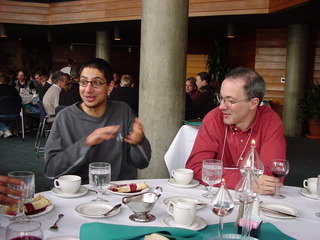
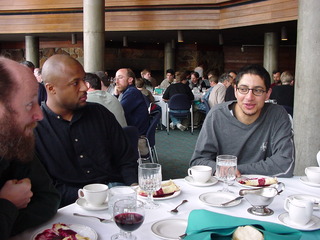
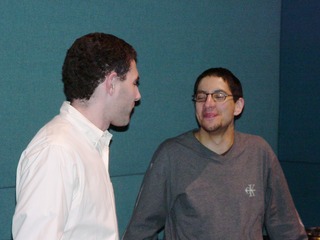
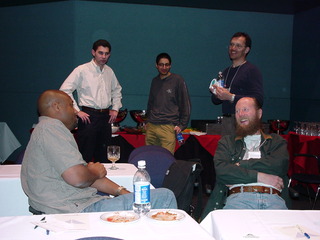
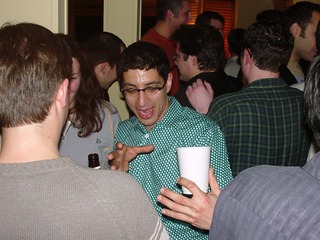
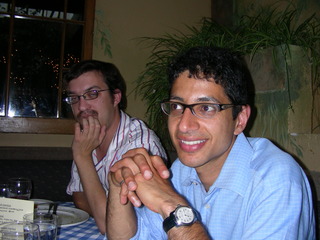
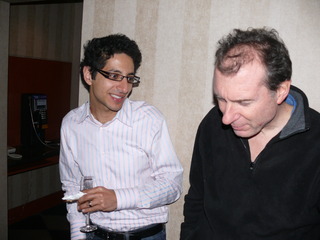
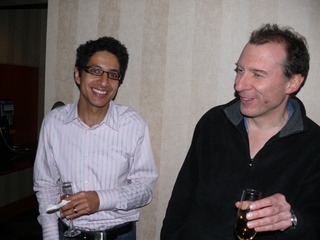
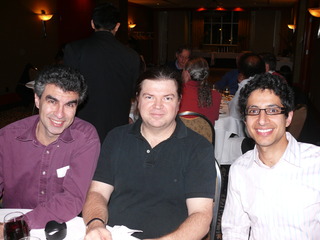
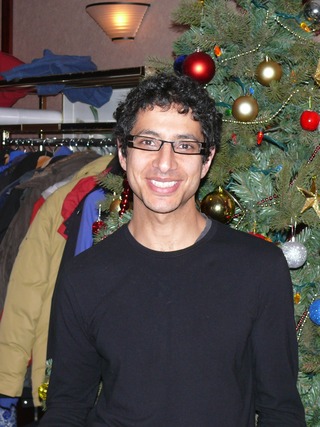
Sam Roweis (1972-2010) Scientist & Engineer
The Department of Computer Science, the Courant Institute, and New York University mourn the untimely death of Professor Sam T. Roweis, on January 12, 2010. Sam was a brilliant scientist and engineer whose work deeply influenced the fields of artificial intelligence, machine learning, applied mathematics, neural computation, and observational science. He was also a strong advocate for the use of machine learning and computational statistics for scientific data analysis and discovery.
Sam T. Roweis was born on April 27, 1972. He graduated from secondary school as valedictorian of the University of Toronto Schools in 1990, and obtained a bachelor's degree with honours from the University of Toronto Engineering Science Program four years later. His first exposure to AI and neural computation occured when--as an exceptional undergraduate--he took the graduate-level Neural Network course taught by Geoffrey Hinton. Here Sam discovered what would become his lifelong interest: unlocking the mysteries of intelligence; motivating all his work was a dream to understand human intelligence, and to build intelligent machines.
In 1994 he joined the Computation and Neural Systems PhD program at the California Institute of Technology, working under the supervision of John J. Hopfield. Sam made several contributions to the then-nascent field of molecular and DNA computing. With his contemporary Erik Winfree and others, he made a proposal for a sticker-based model of computation. But the main topic of his thesis was speech recognition, time-series analysis, and dynamical systems modeling. A central theme of his research was the systematic use of probabilistic frameworks to formulate and analyze learning algorithms. He realized that non-linear dynamical systems could be learned using the Expectation-Maximization (EM) algorithm. He proposed a variation of the well-established Hidden Markov Model (HMM) method for speech recognition, and he showed how a new form of Independent Component Analysis (ICA) could be used to separate multiple audio sources from a single microphone signal. He also realized that Principal Components Analysis (PCA) could be re-interpreted as the limit of a probabilistic model. His PhD research culminated with the publication of a landmark 1999 article, co-authored with Zoubin Ghahramani, that demonstrated that HMM, ICA, PCA, and Kalman Filters can all be seen as variations on a single linear Gaussian model.
After earning his PhD in 1999, Sam took a postdoctoral position in London with the Gatsby Computational Neuroscience Unit founded by Geoff Hinton. Sam's enthusiasm and creativity played an important role in making the Gatsby Unit one of the top labs in computational neuroscience. At Gatsby, Sam started an incredibly fruitful long-distance collaboration with Lawrence Saul (then at AT&T Labs in New Jersey), which led to the Locally Linear Embedding algorithm (LLE). The LLE paper, published in Science in 2000, revolutionized the field of dimensionality reduction, and gathered over 2700 citations in less than 10 years. It spurred an entire new sub-field of machine learning, called manifold learning, and gathered a considerable amount of interest from other technical fields, including applied mathematics. With LLE, Sam and Lawrence taught us to "think globally and fit locally": Given points in a high-dimensional space, local geometric relations among groups of nearby data points capture both local and global structure in the whole data set. This permits organization, visualization, and search for large, complex data collections. The method has had numerous applications in data visualization for biology, neuroscience, and the social sciences.
After his postdoc, some time at MIT, and a stint with the startup company WhizBang! Labs, Sam took a faculty job at the University of Toronto, to which Geoff Hinton had returned. In making this choice Sam rejected several extremely prestigious offers for the unparalleled intellectual atmosphere he found at Toronto surrounding his mentor, Geoff.
In this period, two new unsupervised methods he developed were Stochastic Neighborhood Embedding (SNE) and Neighborhood Component Analysis (NCA). Both methods use the idea of learning a function that maps datapoints into a space in which semantically similar objects are nearby, while semantically dissimilar objects are far apart. SNE has become a popular method for visualizing and organizing high-dimensional data, while NCA has spurred a resurgence of interest in methods that learn similarity metrics from data. Sam published a set of papers on speech and signal analysis, particularly using factorial HMM and hierarchical models. He was appointed to a Canadian Research Chair in statistical machine learning, and received a Sloan research followship in 2004.
In 2005 Sam spent a semester at MIT. Capitalizing on his work on blind source separation, he co-authored a landmark 2006 SIGGRAPH paper with Rob Fergus and others on removing camera shake from a single photograph. It was during his stay in Cambridge, MA that he met his wife, Meredith Goldwasser.
While at MIT and upon his return to Toronto, he focused on using machine learning and statistical methods to contribute to other sciences, such as astronomy and biology. He started an extremely fruitful collaboration with NYU astronomer and secondary-school friend David W. Hogg. Their most visible success together was a kind of search engine for the sky, called Astrometry.net. The system can take any picture of the sky from any source, and instantly identify the location, orientation, and magnification of the image, as well as name each object (star, galaxy, nebula) it contains. Sam and David introduced astronomers to a number of large-scale statistical methods that enabled increasingly automated and precise data analysis. One of their methods can even estimate the year at which an image was taken by measuring tiny variations in stellar positions.
In 2006 he was named a fellow of the Canadian Institute for Advanced Research (CIfAR) and received tenure at Toronto. Sam was not just a scientist, however, he was also an engineer. When Meredith took a job at Genentech in San Francisco, Sam took an opportunity to have a more direct impact on the world by joining Google's research labs in San Francisco and Mountain View in 2007. He was fond of saying that Google's search engine is one of the closest things we have to an intelligent computer.
In the summer of 2008, Sam and Meredith's twin daughters, Aya and Orli, were born in San Francisco. They were born very prematurely and had to be kept in intensive care unit for many weeks. Sam took an extended paternity leave from Google to take care of the twins.
Sam's stay at Google, and the success of his computational astronomy work, had renewed his interest in academic research. He decided to join the Computer Science Department at NYU's Courant Institute as an Associate Professor, and moved the family to New York City in September 2009. At NYU, his collaboration with David Hogg redoubled, as did his ongoing collaborations with Rob Fergus and Yann LeCun. His passing leaves many open threads, and many projects unfinished; at the time of his death he was working on beautiful, simple, but game-changing ideas for astronomical data analysis and remote sensing.
Sam had a singular gift: to him, any complex concept was naturally reduced to a simple set of ideas, each of which had clear analogies in other (often very distant) realms. This gift allowed him to explain the key idea behind anything in just a few minutes. Combined with contagious enthusiasm, this made him an unusually gifted teacher and speaker. His talks and discussions were clear and highly entertaining. His tutorial lectures on graphical models and metric learning, available on video at videolectures.net, have been viewed over 25,000 times. He would often begin group meetings by giving a puzzle, the solution of which was always beautiful, enlightening, or hilarious.
Many members of the research community became friends with Sam, because of his warm and friendly personality, his communicative smile, and his natural inclination to engagement and enthusiasm. Sam inspired many students to pursue a career in research, and to focus their research on machine learning and artificial intelligence. Already in his short time at NYU, Sam had become a key member of the computer science department, thanks to his broad interests, his clear-sightedness, his sense of humor, his warmth and his infectious enthusiasm. He was also a loving and devoted father to the twins and husband to Meredith.
Sam is greatly mourned by his colleagues and students at NYU, who extend their sympathy to his many friends in the broader research community, especially at the University of Toronto, the Gatsby Neuroscience Unit, and Google Research. Most of all, we express our deepest sympathy to his wife Meredith, his twin baby daughters Aya and Orli, and his father Shoukry.
The Sam Roweis Memorial Blog is collecting memories of Sam by friends and colleagues.
The Sam Roweis Memorial Fund was setup by the NIPS Foundation to support the care and well being of his family.