 MISHRA 95
Lecture #11
Programming Languages MISHRA 95
 The value of an expression depends only on the values of its
subexpressions, if any.
The value of an expression depends only on the values of its
subexpressions, if any.
---Slide 2---
Common Lisp
 (Natural Language Processing, Computer Vision, Robot
Control Systems, Expert Systems, Neural Networks, Automatic Programming)
(Natural Language Processing, Computer Vision, Robot
Control Systems, Expert Systems, Neural Networks, Automatic Programming)
---Slide 3---
HISTORY
 INTERLISP (PDP 10)
 UCI-LISP (Univ. of Cal. at Irvine)
 Standard Lisp (Univ. of Utah)
---Slide 4---
Common Lisp
---Slide 5---
Lisp Data & Functional Objects
 Self-modifying Lisp programs.
 Embedded languages in Lisp
 Extensible control structures
---Slide 6---
Lisp Objects
 ,
,  ,
, 

A, EVAL, PI, T,
NIL 
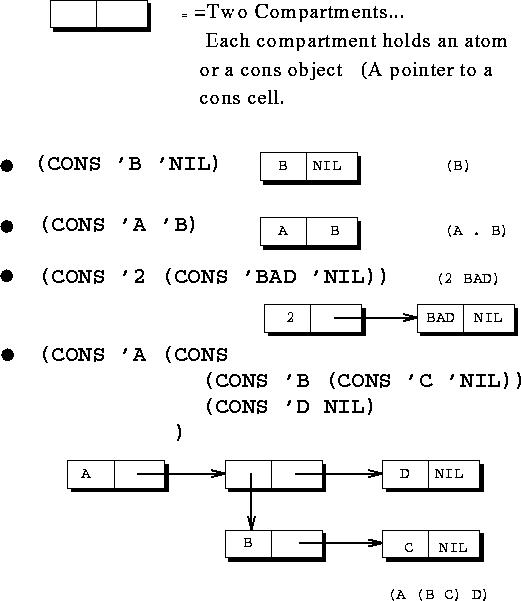
     (CONS 'A 'B)
     (CONS '2 (CONS 'BAD 'NIL))
---Slide 7---
CONS Cells
---Slide 8---
LISTS
LIST
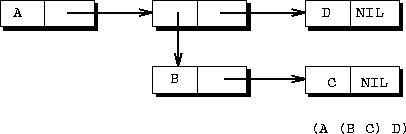
   (LIST 'A (LIST 'B 'C) 'D)
=> (A (B C) D)
   (LIST 'B NIL)
=> (B NIL)

   (LIST)
=> NIL
(An Atom not a
CONS cell)
---Slide 9---
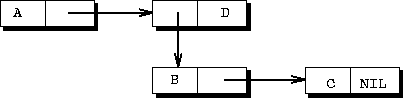
Proper and Improper Lists
(A (B C) . D)
---Slide 10---
List Operations
CAR:
CDR:
CAR & CDR
NIL

 (CAR '(A B C))                         => A
 (CDR '(A B C))                         => (B C)
 (CAR (CDR (CAR (CDR '(A (B C) D)))))   => C
---Slide 11---
List Predicates

T = True, NIL = False 
ATOM: True iff an atom
   (ATOM 'NIL)                 =>   T
   (ATOM '(X Y))               =>   NIL
CONSP, LISTP, 
NULL: True iff an empty list (e.g., NIL)
   (NULL 'NIL)                 =>   T
   (NULL 'X)                   =>   NIL
ZEROP, NUMBERP, 
---Slide 12---
Conditional Form
IF & COND
   (IF <test-predicate> <then-clause> <else-clause>)
   (COND (<test-1> <result-1>)
         (<test-2> <result-2>)
         ...
         (<test-n> <result-n>)
         )
IF form is equivalent to (COND (<test-predicate> <then-clause>)
(T <else-clause>))
COND, it
evaluates each of the test forms in order (i.e.,
<test-1>, <test-2>,  .
.
NIL,'' its
corresponding result form (i.e., <result-i>) is
evaluated and its value is returned as the result of the
COND.
---Slide 13---
Simple Examples
   (IF (ATOM 'X) 'YES 'NO)              =>  YES

   (COND ((ATOM 'X) 'YES)
         (T 'NO))                       =>  YES

   (DEFUN LENGTH (LIST)
         (IF (NULL LIST)
             0
             (+ 1 (LENGTH (CDR LIST)))))
LENGTH Computation
   (LENGTH '())                         =>  0

   (LENGTH '(C))
=  (+ 1 (LENGTH '()))                   =>  1

   (LENGTH '(B C))
=  (+ 1 (LENGTH '(C)))                  =>  2

   (LENGTH '(A B C))
=  (+ 1 (LENGTH '(B C)))                =>  3
---Slide 14---
LISP EVALUATOR: EVAL
 S-expression (Symbolic Expn)
 Values
Evaluation Order = ``Inside-Out''
NIL are constants and have predefined
values. Symbols can be SET to a value in the course of
execution.
(SET 'A '(X Y)) => A = (X Y)
CAR. The CDR of the list is treated as
the arguments.
Evaluation proceeds by applying the function (CAR) to
the argument (CDR)
   (+ 2 4)                        =>  6
   (+ (CAR (CDR (LIST 2 3))) 4)   =>  7
---Slide 15---
QUOTE
 If the symbol in the functional position is a special
form, then the usual evaluation rule is replaced by a
special one before the arguments are evaluated
If the symbol in the functional position is a special
form, then the usual evaluation rule is replaced by a
special one before the arguments are evaluated

QUOTE  Special Form
   (QUOTE A)                  => 'A
   (QUOTE (A B (QUOTE C) D)   => '(A B 'C D)
   (SET 'PI 3.1415)            =>  PI = 3.1415
                               =>  'PI = PI
   (SETQ B 'X)
   (SET B 'Y)                  =>  B = X
                               =>  X = Y
   (CONS 3 '(+ 5 6))           =>  (3 + 5 6)
   (+ '3 '4)                   =>  7
---Slide 16---
EVAL
   (SETQ A (LIST '+ 5 6))      =>  A = (+ 5 6)

   (CONS A '(IS MY RESULT))
=> ((+5 6) IS MY RESULT)

   (CONS (EVAL A) '(IS MY RESULT))
=> (11 IS MY RESULT)
---Slide 17---
USER-DEFINED FUNCTIONS
(DEFUN <function-name> <argument-list> <body>)
DEFUN
<function-name>NIL
<argument-list>EVAL
procedure
<body>
---Slide 18---
Examples: APPEND & REVERSE
   (DEFUN APPEND (X Y)
      (IF (NULL X)
          Y
         (CONS (CAR X) (APPEND (CDR X) Y))))


   (DEFUN REVERSE (LIST)
      (IF (NULL LIST)
          'NIL
          (APPEND (REVERSE (CDR LIST))
                  (CONS (CAR LIST) 'NIL))))
[End of Lecture #11]